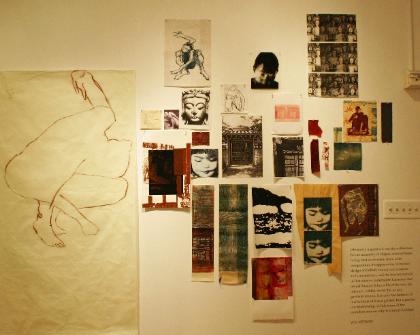
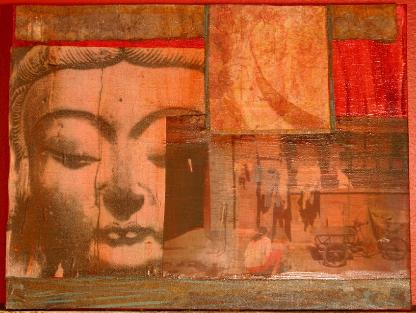
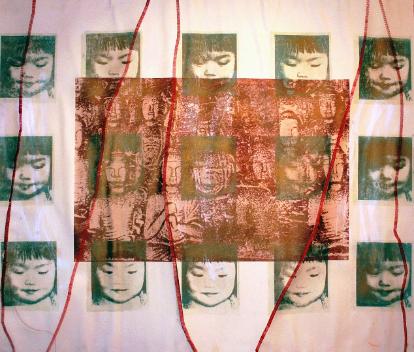
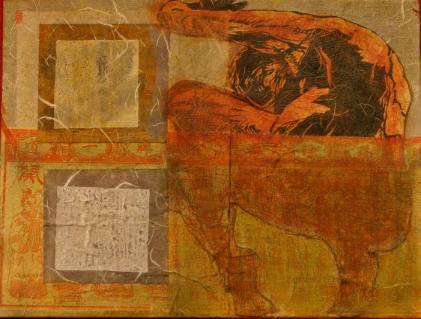
My current work includes a collection of inter-related mixed media books, paintings and prints created beginning around 2000 and continuing to the present. Each of the included segments interweaves my areas of interest as an artist. My process is to employ my own drawings, photographs and prints in my work. I also use collected materials, ephemera from previous projects, and found images. Media include ink, paint, wax, sewing, collage and found objects. Objects like tin niches (small places of worship) seem to echo the temple and garden entryways I have photographed and become a kind of gateway within a piece. As a printmaker I have always been interested in the technical overlay of print methods and images. I like to experiment with ways in which printmaking media may begin to come together with painting. As well, the concept of the artist book as an object held in the hand or viewed closely thus creating an intimate interaction between artist and viewer, are all at the center of my visual exploration. The un-named One series of large scale prints was begun in summer 2001 as an exploration into the myth of Persephone and her descent into the underworld. Then the events 9/11 took place. The work was completed as a memorial to the thousands of anonymous people who were lost in the underworld of burning steel. I have recently begun to re-work these images in terms of the un-named and faceless people who are caught in the violence of war or political situations beyond their control. Are they sisters, fathers, mothers or children? How much loss they must have experienced. In my own life, the birth mothers of my daughters, though never to be known, are always present for me like ghosts of memories. In her introduction to Karin Evans’ book, “Lost Daughters of China”, Anchee Min takes on the role of stern Ai- yi or auntie, telling the “raw truth” of their histories. She tells the lost daughters that for their birth mothers, who for whatever tragic reason had to relinquish them, they will be forever “a broken arm hidden inside the sleeve.” Reclaiming the female body I have searched for an image that conveyed essential woman, not determined by notions of age or physical beauty or the gaze. Variations on a simple crouch or squat seem most compelling. It is a stance of our daily life functions of giving birth, of elimination and of bathing. This simple visual metaphor seems an appropriate starting point for reclaiming images of ourselves. These images are intended to transcend specific age and reveal the constant, internal and evolving self found in the private space of thought, body and the personal. The women’s bodies in each piece are close to life size and can be placed on the wall in order to create a dynamic exchange with the viewer. Buddhism On my first trip to China, I brought along a small book of one hundred poems by Han-shan from the T’ang Dynasty. These writings by the reclusive, yet deeply socially aware Buddhist monk who is thought to have lived anywhere between 627 and 750 A.D. I have returned to this volume many times. Here translated by Burton Watson is #29 I spur my horse past the ruined city; The ruined city, that wakes the traveler’s thoughts: Ancient battlements, high and low; Old grave mounds, great and small. Where the shadow of the single tumbleweed trembles And the voice of the great trees clings forever, I sigh over all those common bones— No roll of the immortals bears their names. Han-shan’s poem echoed as I visited famous spots such as Xian’s Terracotta Warriors, the Forbidden City, and the Great Wall and most strongly when walking down an unknown street in a city or looking out a train window across fields lit with many little fires from farmers’ brush piles. It was the unnamed souls of Han-shan’s poems, whose presence is strong in these places that have resonated most deeply for me. China’ s history in the recent centuries makes this sentiment more poignant. Ancient images of the Buddha and the goddess, Guan Yin, who gives solace to the hurt and provides the blessing of children, evoke a place of contemplation and peace. As well I find the ever-transforming garden to be a compelling and hopeful visual metaphor. The works I have created contain layered levels, like pages, that become gateways to new images the same way garden or temple gateways invite exploration and evoke an ancient place often visited perhaps over multiple centuries by anonymous wanderers. |
| Anne Beidler---Artist Statement |
 |
 |
 |
 |